

Payments get BRIC-ed
You can’t outrun USD(T?)

If you’re anything like me, you’re still reeling from the latest installment in the “death of the dollar” cinematic universe (RIP the petrodollar) but I’m sad to report that you must emotionally prepare yourself for another wave. Next week, the BRICS foreign ministers are scheduled to meet in New Delhi ahead of the bloc’s annual summit in September.
As always, intra-bloc payment connectivity and trade settlement will be on the agenda. As always, the foreign ministers will likely produce vague statements about doing something — anything! — about the dominance of the dollar. Headlines about de-dollarization will follow and counterfactuals will be published.
In theory, the BRICS are inching closer to a functional decentralized digital payment system that routes around the dollar entirely. In practice, I’m not so sure. I read the strategy docs for BRICS Pay and found a familiar face acting as a “temporary” bridge currency for the bloc. If you guessed a dollar-backed stablecoin, you were correct. The dollar is so strong that even when building a mechanism to route around the dollar, one must still resort to using an ersatz dollar.
You wonder how the BRICS nations could allow this, but the reality is they may not have much of a choice because of the dollar’s role as a vehicle currency. Let’s take a look at the BRICS and why the dollar is still at the center of it all.
BRICS to I ICE BRUISES
In 1998, Russian foreign minister Yevgeny Primakov took a trip to New Delhi, where he mused about a multipolar future, when India, Russia, and China might create a counterweight to the United States. It took another three years for the BRICs acronym to catch on via a paper by Goldman Sachs Chief Economist Jim O’Neill, titled “Building Better Global Economic BRICs,” which forecasted the expected outperformance of the Brazilian, Russian, Indian, and Chinese economies over the G7 economies. Over the next decade, BRIC countries began to meet on the sidelines of diplomatic forums, at first informally and later officially.
The bloc now includes South Africa (BRICs to BRICS) and more recently Ethiopia, Iran, Egypt, Saudi Arabia, the UAE, and Indonesia accepted invitations (BRICS to “I ICE BRUISES”). Okay, my acronym doesn’t really capture growth potential the way O’Neill’s did but it certainly captures their mood of resentment. The BRICS now account for 40% of global GDP. This is serious economic heft and they’ve been on the move:
They’ve launched serious initiatives: the New Development Bank was inaugurated in 2014 as a counter to the IMF and World Bank, and has approved a total of $40 billion in financing over a decade (with $22.4B disbursed). Peanuts compared to the World Bank’s $161B in 2025 alone, but not nothing!
They’ve become more integrated. According to the United Nations, “Intra-BRICS merchandise trade has expanded more than 13-fold since 2003. Exports reached $1.17 trillion in 2024.”
And they love to talk about payments. Which is why people have a de-dollarization field day when foreign ministers inevitably issue a joint statement about advancing payment initiatives in local currencies.
People always speculate about the creation of a BRICS currency but that is about as realistic as me making it on Broadway (experts are pegging the odds at “not particularly likely, but some local theatre may be looking for someone to play the goat from Wicked”). The Europeans share millennia of proximity, history, culture, and still can’t figure out a monetary union. A unified currency for far-flung countries with nothing but an acronym in common is, on a good day, highly improbable.
But a shared currency isn’t the only avenue to financial integration! Other initiatives include: BRICS Bridge, the bloc’s concept project for a multicurrency central bank digital currency wholesale settlement platform, and a focus of India, this year’s BRICS chair; BRICS Clear, a decentralized cross-border securities settlement and depositary platform for financial markets; and finally, BRICS Pay, which is the retail and commercial layer. Out of the lot, BRICS Pay is the bloc’s most developed alternative to Western systems, but digging around in the strategy documentation, we find that it’s an awfully familiar story.
Definitely not anti-dollar
The BRICS Pay website boldly declares: “Not anti-dollar - we are for de-domination.” (My “Not opposed to the dollar” T-shirt has people asking a lot of questions already answered by my shirt.) Which tells us a lot. BRICS Pay is a decentralized payment ecosystem developed by the bloc’s private sector coordinating body to enable cross-border transactions between BRICS countries in local currencies, without routing through Western financial infrastructure.
In 2018, the project got underway around a core piece of technology called the Decentralized Cross-border Messaging System (DCMS), developed by researchers at St. Petersburg State University. Russian-made, so we can assume it is overbuilt and grudgingly functional. In 2024, a working prototype was demonstrated at the BRICS Business Forum in Moscow, where 5,000+ attendees could top up a digital wallet and make QR code payments at venues in the World Trade Center.
The 2025 BRICS Pay Annual Report (bedtime reading!) put BRICS Pay under discussion, which likely means no consensus was reached on next steps. But given the desire to show that they’re making progress, I anticipate BRICS will make some announcement this year about the continued development of the payment system.
Under the hood
BRICS Pay connects existing national fast payment systems — Brazil’s Pix, India’s UPI, Russia’s SBP, China’s CIPS — through DCMS which at its core is a decentralized messaging system. Much like SWIFT, DCMS moves payment instructions between banks, not money itself. Unlike SWIFT, there is no central owner who can kick a country out, which is rather the point. This point is explicitly made in the technical documents, which have the air of a rejected nightclub-goer opening a new club across the street.
Functionally speaking, let’s say a Brazilian soy exporter wants to get paid by a Russian buyer in local currencies. The bank of the buyer in Russia creates a payment instruction and sends it to the DCMS network, where it hops through chains of intermediate nodes — like a flight with layovers — until it reaches the Brazilian bank on the other end. Each node signs the message cryptographically before passing it on. If it reaches the end intact, money starts moving; if anyone tampers with the message, the signature breaks and the transaction cancels automatically.
But before money can move, the two banks must first have established an Agreement (very technical terms, again very Russian), in which banks establish what currencies they are willing to hold and how much liquidity in said currencies. This is basically a bilateral credit line. No agreement means no transaction. So BRICS Pay is still a series of bilateral currency transactions between banks, just routed away from Western institutions on a Russian messaging system.
Away from the dollar and right back onto the ~dollar
BRICS Pay’s own strategic roadmap publicly admits, albeit buried deep on a website titled docs.brics-pay.com, that for B2B transactions, the system relies on the “temporary use of USDT as one of the bridges.” USDT being……… Tether, a stablecoin pegged one-to-one to the US dollar. Incredible. The system designed to escape the dollar is routed through an artificial one. Documentation is light but we’re guessing Tether is functioning as a conversion mechanism — instead of an illiquid and expensive direct conversion from rupee to reais, the conversion goes from rupee to USDT to reais. In other words, USDT sits in the middle of transactions as a common denominator.
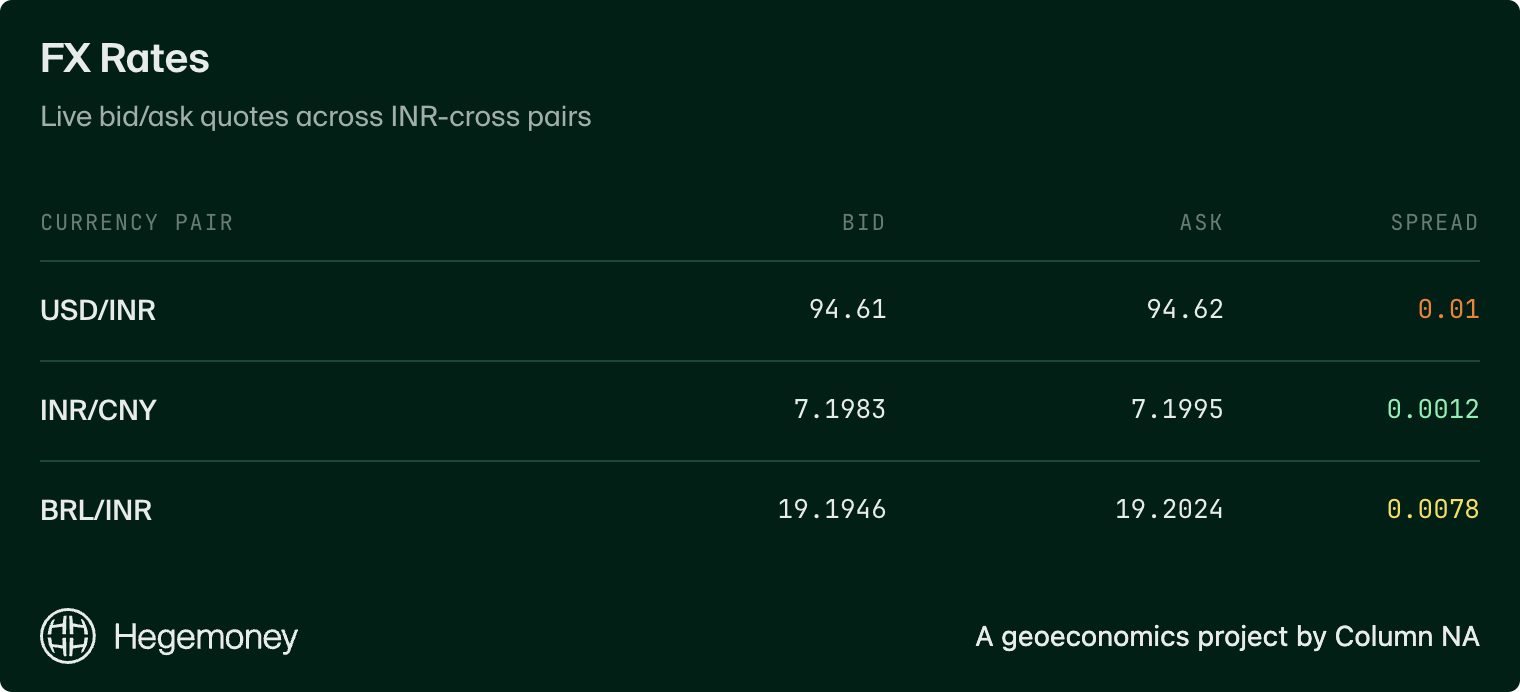
The reason a bridge currency is needed at all goes back to what Paul Krugman identified in 1980 as the vehicle currency — the dominant currency that sits in the middle of global trade because routing through it is simply cheaper than converting directly. Look at the spreads in the chart below. The USD/INR spread is razor thin. The BRL/INR spread is nearly eight times wider. That gap is basically an extra tax on the transaction. Converting between two non-dollar currencies directly is expensive precisely because there are no deep, liquid markets for most BRICS currency pairs — not enough two-way flow to attract market makers willing to quote tight prices at scale. Until then, the dollar — or an ersatz version of it — stays in the middle.
And then there is the China problem. USDT is banned in China: Beijing outlawed cryptocurrency trading in 2021. There does seem to be an exception for government approved projects, but who knows what that means. The strategic vision laying out Tether’s role was published in September 2025, so it’s possible the BRICS Pay plumbing has since evolved. However, as written, the bridge currency for the bloc’s payment system is illegal in the bloc’s largest economy. The “government-approved projects” exception could be the saving grace, but again, who knows!
When will I be able to BRICS Pay for a Chipotle burrito?
Don’t hold your breath. BRICS began as an acronym coined by Goldman Sachs economists, and the bloc has spent two decades trying to grow into it. 40% of global GDP and $1.17 trillion in intra-bloc trade is real weight. But economic weight alone doesn’t make monetary and commercial integration easy. Again, the Europeans had millennia of shared history and are still working out their differences.
As for the payments system designed to liberate them from Western oppression? Phase 3 (2028-2030) of BRICS Pay plans to retire USDT in favor of CBDCs, while beginning to explore a universal unit of account for the bloc they are calling the BRICS Unit. Candidates for backing the unit include commodity bundles and tokenized energy. In other words, they plan to replace a “temporary use” dollar-pegged stablecoin with CBDCs in development, and eventually something else, anything else.
Just don’t ask them what.1